A content journey connects your story to the questions buyers ask. Here's how to map coverage, measure progress, and plan for AI-assisted research.
Key Takeaways
A content journey connects the story you take to market with the questions buyers need answered. Here's how to make that idea useful:
- Organize around topics, not just formats. A content journey brings together the assets that help a particular audience understand a topic, evaluate an approach, and make a decision. Map the journey across funnel stages and include sales materials, so your strategy reflects more than what appears on your website.
- Define coverage before creating more. A journey is full enough when it answers the priority audience's important questions across the stages relevant to their decision. Check for accuracy, audience fit, and useful next steps, not just whether every box contains a blog post, guide, or deck. An existing asset may need an update rather than a replacement.
- Measure progress, not just consumption. Views and downloads show engagement, but they don't tell the whole story. Define what a meaningful next step looks like at each stage, then measure the transitions you can observe. Keep your cohort, denominator, and time window explicit, and treat progression as a diagnostic rather than proof of causation.
- Expect detours and blind spots. Buyers may enter at a product page, revisit an educational article, share content with colleagues, or research in places your analytics cannot see. Use the funnel to plan and investigate patterns, not to insist that everyone follow the same sequence. Combine behavioral data with feedback from sales and buyers.
- Plan for AI-assisted research. People may ask AI tools to explain problems and compare approaches before they reach your site. Build connected public content that answers related questions clearly and provides useful context. This supports discoverability, but it cannot guarantee that an AI system will find, cite, or accurately summarize your content.
- Connect the map to everyday work. A shared messaging foundation, a current view of assets, and regular reviews of gaps and engagement give marketing and sales a common starting point. Use that view to decide what to update, reuse, connect, or create next, and revisit it as buyer questions and market conditions change.
- Keep the next step current. Give each stage a Stage CTA, and use a dynamic CTA link in the assets that precede it. The link resolves to the current live target for that stage when someone clicks, so you can change the destination once without editing every page.
More content, less clarity
A product marketer wants to know whether the company's positioning is reaching buyers and helping them move forward. A demand generation leader needs to decide what to promote next. A seller wants the latest answer to a prospect's question, preferably before the call starts.
Meanwhile, the material they need is scattered across the website, shared drives, campaign folders, sales decks, and old launch plans. There may be five versions of the same story, but no obvious answer to a more basic question: Do we have the right content to help a buyer make progress?
The problem is bigger than keeping a library tidy. A list of assets can tell you what exists, but it doesn't necessarily show which audience each piece serves, where it fits in a buying decision, or what happens after someone engages with it. And when buyers use AI tools for research, some discovery can happen outside the paths your analytics can see.
The answer isn't simply to publish more. It's to manage content as a set of journeys.
What is a content journey?
A content journey is the collection of content that helps a particular audience explore a topic and move toward a decision. It connects what you take to market, your topics and messages, to the questions buyers ask as they learn, evaluate, and act.
Start with a topic that matters to your business and an audience that cares about it. Then map relevant assets across awareness, consideration, and decision. Include the materials sales uses in conversations, not just the assets marketing publishes. Depending on your business, the journey can also extend into onboarding, adoption, or expansion.
The map is both a planning tool and a measurement framework. It shows what you have, what's missing, and where you want to help someone go next. It also gives product marketing a way to assess a message across the funnel rather than judging each asset in isolation.
A journey in practice
Imagine a company selling a workflow tool. One of its topics is reducing handoff confusion between teams, and its primary audience is an operations leader.
An awareness article might help that leader recognize the symptoms of a broken handoff. A consideration guide could compare ways to improve the process and explain the trade-offs. A decision-stage page might answer questions about implementation and fit. A sales deck or conversation guide could help address the specific concerns that surface with the buying team.
These assets don't need to be consumed in that order. Their job is to work together: wherever someone enters, they should find a clear answer and a relevant way to go deeper. The awareness article might link to the guide; the guide might connect to the implementation page. Sales can use the same story when a prospect arrives with a question that public content hasn't resolved.
When is a journey full?
A journey is full enough when it gives a priority audience useful answers across the stages that matter to their decision, and offers a sensible next step from each one. That's a more useful standard than requiring a blog, webinar, case study, and deck for every topic.
Build a simple map with topics and audiences on one axis and stages on the other. For each important intersection, record the asset, its owner, the question it answers, its intended next step, and when it was last reviewed. Then look beyond whether a box is occupied. A dated deck, an asset aimed at the wrong persona, or a page that answers a different question may not provide meaningful coverage.
A practical coverage check
For each priority journey, ask:
- Awareness: Can the buyer recognize and understand the problem in their own terms?
- Consideration: Can they explore approaches, criteria, and trade-offs without jumping straight to a product pitch?
- Decision: Can they find the information they need to assess fit and take a relevant next step?
- Sales: Can the team find current material to answer objections and support the conversation?
- Connections: Does each asset offer a useful next destination or action for someone who wants to continue?
- Quality: Is the content accurate, current, audience-appropriate, and consistent with the story you want to tell?
Prioritize the gaps that matter
Not every empty cell deserves a new asset. Prioritize a gap when it affects an important audience, a strategic topic, or a question that regularly comes up in buyer conversations. Consider whether an existing piece can be updated, repurposed, or linked more effectively before creating something new.
A journey can also be overfull. If several assets answer the same early-stage question but none helps a buyer evaluate their options, another awareness post may add noise rather than momentum. Coverage should reflect the decision you're trying to support, not the volume of content your team can produce.
Is the journey doing its job?
A full journey is a starting point, not a result. The goal is to help people make progress: from recognizing a problem to exploring an approach, and from evaluation to a decision. Measurement should ask how effectively each stage helps people reach a meaningful next stage.
Begin by defining what progress looks like for each transition. An awareness article might invite a reader to explore a deeper guide. A consideration guide might lead to a product page, an assessment, or a conversation with sales. A decision-stage asset might help a prospect resolve a final question. The right next step depends on the buyer and the topic; it doesn't have to be a form submission.
Measure the transitions you can observe
For each journey, review reach and engagement alongside progression. Views and downloads can show which assets attract attention. A next-step click or a later visit to an asset mapped to another stage can show observable movement. Sales feedback can add context about whether the content is useful in actual conversations.
For example, choose a cohort of people who engaged with an awareness asset during a defined period. Of those you can recognize across interactions, calculate the share who subsequently engaged with a consideration asset within a consistent time window. Compare that rate over time or across similar journeys, alongside the number of people observed. Then inspect the handoff: Is the next step visible? Does the destination answer the question the first asset raised?
This is a diagnostic, not proof that the first asset caused the later engagement. Tracking coverage, consent choices, anonymous visits, multiple devices, and interactions outside your site can all leave parts of the journey unseen. Keep the denominator and time window explicit, and avoid treating missing activity as evidence that nothing happened.
The happy path isn't the only path
Buyers don't always move neatly from awareness to consideration to decision. Someone may arrive at a product page first, return later to an educational article, share a guide with a colleague, or disappear into an internal discussion. Different members of a buying group may engage with different pieces of the same journey.
So don't optimize only for a single prescribed sequence. Look at useful entry points, revisits, and different next steps as well as stage-to-stage movement. Use observed patterns to ask better questions, then combine the numbers with feedback from sales and your audience. A journey map should make room for how people actually buy.
AEM, AEO, GEO, and the AI-assisted journey
AI adds another layer to content strategy. A buyer may ask an AI assistant to explain a problem, compare approaches, or summarize information before ever visiting a vendor's site. Some of that research belongs to what marketers call the dark funnel: activity that influences a decision but is difficult to observe directly in conventional attribution.
You'll hear terms such as AI engine marketing (AEM), answer engine optimization (AEO), and generative engine optimization (GEO). Definitions vary, but the practical concern is similar: how can your information be useful and discoverable when an AI-mediated experience helps someone research a question?
Content journeys offer a way to organize that work. Instead of chasing isolated prompts, map the questions an audience might ask as its understanding develops. Make sure your public content answers those questions clearly, explains relevant context and trade-offs, and connects to related material. Sales assets may complete the internal journey, but material behind a login or shared privately won't necessarily be accessible to an AI research tool.
Make the content useful, not just machine-readable
Write for people first: use descriptive headings, direct answers, substantive explanations, and links that help readers explore the next question. Keep information current and make important public pages accessible to search systems. A coherent set of pages can help you cover related questions, but it cannot guarantee an AI system will select, cite, or accurately summarize your content.
Review whether your public content appears in relevant AI experiences and whether linked pages receive visits, while recognizing the limits of what those observations reveal. Test representative questions periodically, inspect the answers, and improve unclear or missing content. Treat the results as directional: responses can vary, and an unseen influence is not the same as a measurable conversion.
Bring content journeys together with Conjour
Content journeys work best when the map, the messaging, and the assets don't live in separate silos. Conjour gives your team a shared foundation for messaging and buyer context, then connects it to content work.
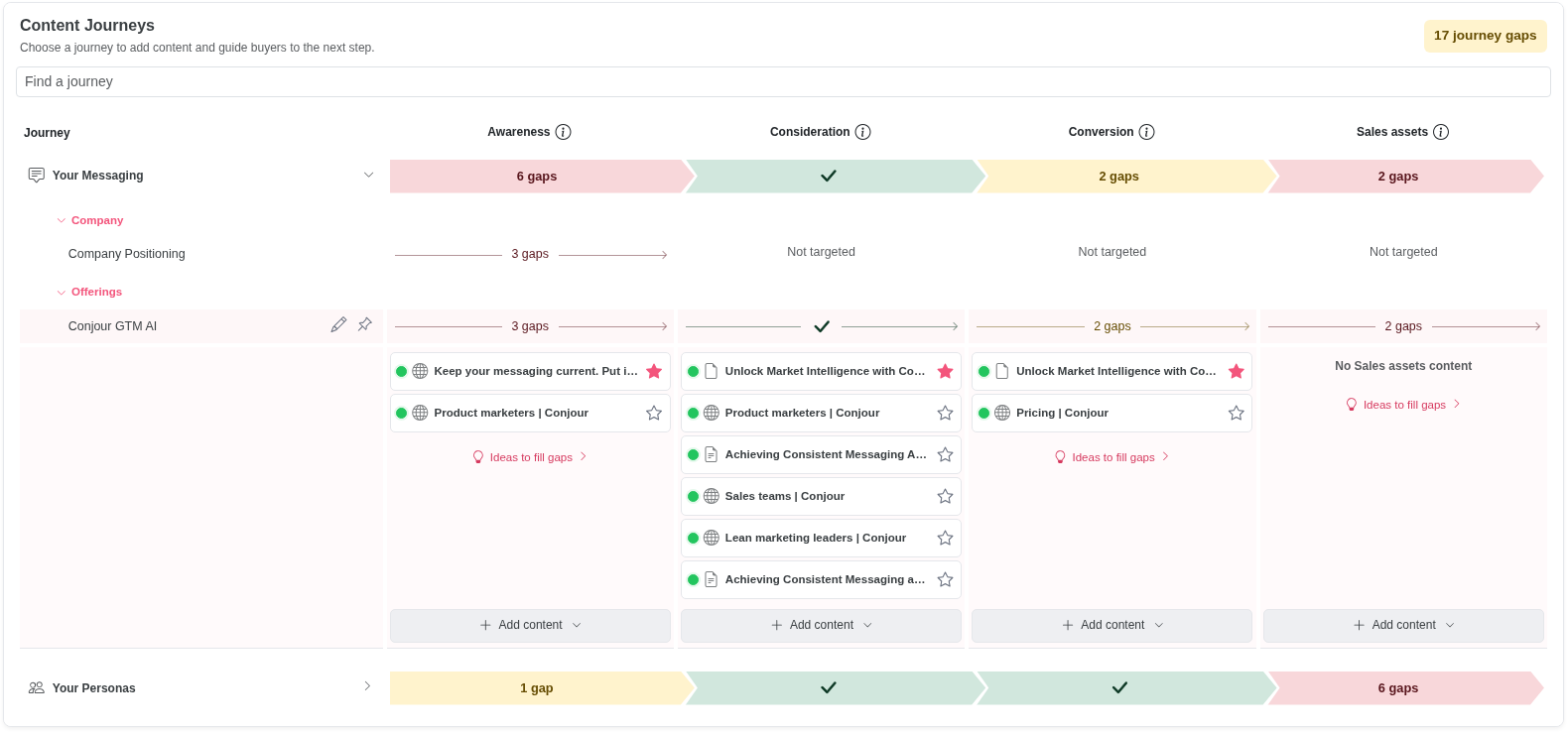
Organize assets by topic, persona, stage, and campaign to see what exists and where there are gaps. Reuse existing content or generate drafts for the next piece you need, grounded in your shared story. Review and refine those drafts before putting them to work.
Conjour analytics connects views, downloads, stage progression, and topics so you can explore engagement across the journey. To measure activity, install tracking and connect assets to external URLs or downloads. Use those signals alongside sales feedback and your broader analytics to decide what to improve next.
Keep the next step current with dynamic CTAs
A journey only works if each asset offers a useful next step, and if that next step stays current as your content changes. In Conjour, each stage has a Stage CTA: the live destination you want someone to reach at that point in the journey.
Assets can include a dynamic CTA link that resolves when someone clicks, so readers land on the next stage's current Stage CTA. Swap a Stage CTA from a guide to a product page, and every existing dynamic CTA link that routes to that stage follows it. You change the destination once, without editing every page, email, or post that pointed there.
Program CTAs route within that program first, and Core Content CTAs stay in Core Content. If a later stage is still a draft or empty, the link skips ahead to the next available live target, then to your account website as a final fallback.
The link at the end of this post is a dynamic CTA link. It will resolve to the current destination, even if that destination changes later.
Find your next content move
Bring your content, messaging, and buyer journeys together. Explore Conjour.